EU Flag

UK, EU propose New Framework on Northern Ireland Border

| By Alexander Haidar |

On February 27, 2023 the British Prime Minister, Rishi Sunak, and President of the European Commission, Ursula von der Leyen announced a tentative post-Brexit trade agreement concerning Northern Ireland.[i] The existing Northern Ireland Protocol is an agreement which came into effect in January of 2021 as part of the Brexit negotiations between the European Union (EU) and the United Kingdom (UK) to address trade on the border between Northern Ireland (a part of the UK) and the Republic of Ireland (an EU member state). The Protocol sought to prevent the need for a ‘hard border’ between Northern Ireland and the Republic of Ireland by essentially keeping Northern Ireland within the EU’s single market for goods and maintaining regulatory alignment with EU rules.[ii] Since implemented, goods entering Northern Ireland’s ports from Great Britain (no longer part of the EU) became subject to checks and controls to ensure that they comply with EU standards. The Protocol also included provisions for the Northern Ireland Assembly to vote on whether to continue the arrangements after four years, with the possibility of extending them for another four years if both the EU and UK agree.[iii]

The Northern Ireland Protocol has been a source of controversy and tension between the UK and the EU, as some pro-unionist political parties such as the Democratic Unionist Party (DUP) in Northern Ireland felt that it created barriers to trading and undermined Northern Ireland’s position within the UK. There have also been difficulties in implementing the Protocol, with some businesses experiencing disruption and delays in trade between Great Britain and Northern Ireland.[iv] Overall, the Northern Ireland Protocol was a complex and important agreement which marked a milestone of the Brexit process, however, it will likely be replaced by legislation based on the Windsor Framework. The deal outlined by the UK and the EU is the culmination of months of negotiations between both parties to find a new approach to post-Brexit international trade policy across the only UK-EU land border. During a joint press conference at Windsor castle, both leaders announced their hope that this new approach will result in an effective solution to the post-Brexit trade disputes in Northern Ireland:

“This new Framework will allow us to begin a new chapter. It provides for long-lasting solutions that both of us are confident will work for all people and businesses in Northern Ireland.”[v]

 – EU President von der Leyen

“Today’s agreement is about preserving that delicate balance and charting a new way forward for the people of Northern Ireland.”[vi]

– UK Prime Minister Sunak

At the press conference, Sunak explained the three main achievements of the revised protocol as follows: “Delivering smooth flowing trade within the whole United Kingdom; Protecting Northern Ireland’s place in our Union; Safeguarding sovereignty for the people of Northern Ireland.”[vii] In this plan, goods traveling from the UK with a final destination of Northern Ireland will travel through a new “green lane,” while those with a final destination of Ireland (EU) will travel through a “red lane” where EU checks and regulations will be followed. It will also allow British residents of Northern Ireland to forgo the customs paperwork previously imposed on them, while also allowing them to completely access British products and services. Finally, it will equip the democratically elected Northern Ireland Assembly with the ability to “pull an emergency brake” if businesses in Northern Ireland are negatively impacted from EU regulations.

The land border between Northern Ireland and the Republic of Ireland is particularly important for trade. Being relatively porous, with many small roads and crossings that are used by individuals and businesses to move goods and people between the two countries, the border allows for goods and services to be transferred from the UK into the EU fairly easily, which is particularly important for sectors such as agriculture and manufacturing that rely on just-in-time supply chains. Additionally, Northern Ireland’s ports, particularly the port of Belfast, facilitate trade with the rest of the UK and beyond. The port of Belfast is a major hub for imports and exports, particularly in the areas of agri-food and manufacturing.[viii]

The DUP has yet to officially release a comment on the content of the Windsor Framework but indicated that they will be reviewing it carefully.[ix] As it also remains yet to be passed by the British parliament, the true impact of the Windsor Framework on trade between Ireland and the UK will depend on the specific trade agreements and laws negotiated under this new approach. In particular, the UK may seek to negotiate new trade deals that compete with existing trade agreements between Ireland and other countries to benefit from the removal of regulatory barriers for goods traveling to Northern Ireland from the UK. The UK’s new direction towards maintaining national security while also protecting trade routes to the EU via Northern Ireland has yet to be implemented and tested, however, it could lead to a significant shift in the UK’s approach to trade with EU countries.


[i] “The Windsor Framework: A New Way Forward.” GOV.UK, Controller of His Majesty’s Stationery Office, Feb. 2023, https://assets.publishing.service.gov.uk/government/uploads/system/uploads/attachment_data/file/974907/EYFS_framework_-_March_2021.pdf.

[ii] Piper, Elizabeth, et al. “Explainer: What Is the Northern Ireland Protocol?” Edited by Janet Lawrence and Christina Fincher, Reuters, Thomson Reuters, 26 Feb. 2023, https://www.reuters.com/world/uk/talks-post-brexit-northern-ireland-trade-edge-closer-deal-2023-02-20/.

[iii] “Democratic Consent Mechanism.” Northern Ireland Assembly, 2023 Northern Ireland Assembly Commission, 2021, http://www.niassembly.gov.uk/assembly-business/brexit-and-beyond/democratic-consent-mechanism/.

[iv] Ferguson, Amanda. “Northern Ireland Business Groups Welcome Brexit Deal ‘Certainty’.” Reuters, Thomson Reuters, 27 Feb. 2023, https://www.reuters.com/world/uk/northern-ireland-business-groups-welcome-brexit-deal-certainty-2023-02-27/.

[v] “Statement by President Von Der Leyen at the Joint Press Conference with UK Prime Minister Sunak.” European Commission, European Union, 27 Feb. 2023, https://ec.europa.eu/commission/presscorner/detail/en/statement_23_1270.

[vi] “PM Speech on the Windsor Framework: February 2023.” GOV.UK, His Majesty’s Government, 27 Feb. 2023, https://www.gov.uk/government/speeches/pm-statement-to-the-house-of-commons-27-feb-2023.

[vii] Ibid.

[viii] Carswell, Simon. “Belfast Port Reports Surge in Trade Due to Fewer Post-Brexit Checks.” The Irish Times, The Irish Times, 1 Feb. 2022, https://www.irishtimes.com/business/belfast-port-reports-surge-in-trade-due-to-fewer-post-brexit-checks-1.4791231.

[ix] Haplin, Padraic, et al. “Northern Ireland’s DUP Leader: We Are Studying New Brexit Deal Texts.” Reuters, Thomson Reuters, 27 Feb. 2023, https://www.usnews.com/news/world/articles/2023-02-27/northern-irelands-dup-leader-we-are-studying-new-brexit-deal-texts.

Morocco Business Conference

Doing Business in Morocco

The Virginia Economic Development Partnership International Trade team hosted a  conference on Wednesday, August 24th, to talk about business opportunities in Morocco. The guest speaker for the event was David Garay, Managing Partner of Indegate Consulting in Casablanca. The event was held online as part of the VEDP’s program to promote international trade.

From his office in Casablanca, Mr. Garay spoke extensively and enthusiastically of the many advantages of doing business in and through Morocco as entryway to Africa for international business development. Economic insights and opportunities of Morocco and Africa highlighted by Mr. Garay included:

  • Morocco has multiple free trade agreements with the EU, US, and Africa, and is in negotiations with Canada
  • Morocco is a multilingual country with English, French, Spanish, and Arabic used throughout the business community
  • Morocco has 38 ports, including Tanger — the largest port in North Africa. Tanger handled 9 million TEUs in 2021
  • Casablanca Airport is the #1 Europe-Africa hub airport
  • The country has a modern infrastructure, including 2000km of motorways, the first high-speed train in Africa connecting Tanger and Casablanca, and tramways in Rabat and Casablanca
  • By 2030 Morocco is forecast to become the #1 car manufacturer in Africa
  • 70% of the word’s phosphate reserves, used in fertilizer production, is found in Morocco
  • The Morocco defense market is valued at $6.8B in 2022 and estimated to grow more than 6% in 2023-2027
  • The Noor Solar Project is the largest African solar plant, leading the way in renewable energy in Africa

The VEDP will be hosting a trade mission to South Africa and Morocco from November 7th – 11th, 2022. Virginia-based companies can sign up for this event at the following link:

https://www.eventbrite.com/e/trade-mission-to-south-africa-morocco-2022-registration-298319972067

Previous VEDP international trade briefings are available at:

https://exportvirginia.org/resources?rtype=40

For further information regarding business in Morocco and Africa, contact David Garay and Indegate Consulting at the following:

davidgaray@indegate.com

edgarcayuelas@indegate.com

https://indegate.com/

(+212) 6 06 06 53 39

(+212) 6 56 60 66 73


VEDP Africa Business Conference

Africa Business Trends and Outlook

By Kai Heaven |

The Virginia Economic Development Partnership hosted its Africa Business Conference at the Tower Club in Tyson’s Corner, Virginia on August 26, 2022. Ellen Meinhart and Mercedes Sanchez, VEDP Senior International Trade Managers, and Ed Laughlin, VEDP Global Defense Manager, were on hand to make introductions and start off the event.  Richard Zurba of Zurcom International based in Johannesburg, South Africa gave the main presentation.

Mr. Zurba began the presentation with an overview of past and current African economic facts and trends. Africa is historically known for its abundance of natural resources and its vast population intersecting many races, cultures, and classifications. In recent times, there has been focus on how African states can contribute more to the global economy not only for their own financial gain for the overall advancement of globalization. Nigeria in particular has been a star state, being a part of MINT (Mexico, Indonesia, Nigeria and Thailand), as a group of emerging economies with great possibilities in their future.

The economic growth of African states, Zurba noted, has been noted in industries such as agriculture, mining, energy expansion, and product diversification. The African Union defines The African Continental Free Trade Area (AfCFTA) as the strategic framework for delivering Africa’s goal for inclusive and sustainable development and is a concrete manifestation of the pan-African drive that is popular throughout the continent. This organization has created one common market for African states, most of which have ratified the AfCFTA. Among its goals are common tariffs, standard assessments, sanitary measures, customs regulations, and other solutions to an initially disorganized market situation. The mutuality of the agreement allows for easier analytics and better transparency with the organization and the continent. With the AfCFTA coming into effect in January 2021, it is positioned to make great economic and business relationships globally.

Zurba continued the discussion by looking at African population trends. Zurba explained that African states have seen consistent increases in its population boasting 1.4 billion people today and is expected to grow to 2.5 billion by 2035. It is a continent of a youthful generation with 300 million people comprising the middle class. There has also been a strong shift towards democracy within the continent as African youth are strictly anti-corruption, even towards the politicians of always. They are strongly demanding educational services such as access to universities, technology, and corporate training to make them effective global citizens. Africans in the diaspora, specifically those who grew up in the US are keen on these matters and have even extended themselves to go back to Africa to train their fellow countrymen.

Stemming from Africa’s vast cultural heritage, citizens speak a variety of languages, mainly French and English. It is estimated that about 60% of Africans on the continent speak English and this figure is quickly growing. The United States, which is viewed as the primary source of business and culture also contributes to those changing figures. These factors, coupled with increased access to global information as well as an entrepreneurial and educational focused population provides a unique opportunity for the country to arrange itself for global success. As Zurba previously mentioned, Africa has a youthful population especially in comparison to its global neighbors. By 2050, Chinese, Japanese, and European demographics will shift to the elderly, but Africa will remain youthful. The Under-30 culture in Africa is prolific, boosting its human resource capabilities.

Zurba also touched on the impact of Chinese investment in Africa. Zurba said China has invested a great deal in Africa that has yielded some good such as infrastructure and economic development. However, the Chinese have been acquiring African companies instead of partnering with them which causes some animosity among partner-focused African cultures. The Chinese approach was to prop up the corrupt governments and political leaders to the benefit of China and at the expense of the African people. China may be reducing exports and has decreased their presence in trade shows. COVID restrictions in China could be used to explain the recent decline in Chinese activity. In contrast to the slowing of Chinese investment, the African energy sectors have grown by 10-20%. And with other investments such as $300B received from the European Union, energy and other industries will be observing notable growth rates.

Africa has faced years of exploitation in the past and has positively made a name for themselves on the global stage. As an emerging economy with a youthful populace focused on accountability from governments, educational and technical skill advancement, and many other promising opportunities, Africa will be doing great things for globalization. Increased foreign direct investment as well as training for the large populace are also contributing factors to its success. Expansion to the United States market will give it even more room for growth as the United States is the largest global economy in the world.

The VEDP will be hosting a Trade Mission to South Africa and Morocco November 7th – 11th.  Details are available here, and signup is at https://south-africa-morocco-trade-mission-2022.eventbrite.com.

China Olive Oil Market

China Olive Oil Market Analysis

| By Kimberly Kim |

Q1: Is there any interest from Chinese buyers to purchase US olive oil?

The Chinese middle class is booming and imports of foreign products continue to grow. Chinese consumer market interest in foreign olive oil has experienced an increase in recent years. As more and more Chinese consumers start to appreciate foreign food, especially salads, Chinese imports of olive oil will most likely continue to increase in the coming years.

By far the most imports of olive oil are coming from Spain, which takes more than 80% of the market in China.

80% of the olive oil is consumed in first-tier cities like Shanghai and Beijing. This doesn’t come as a surprise as these cities are more developed, with people who have more money and a stronger desire to try out Western products. 

Chinese consumers mainly prefer extra-virgin oil. Pricing your products at a higher level might not necessarily adversely impact sales, especially as cross-border sales tend to have high logistics costs.

Q2: Is there an agency or business consortium in China sellers can contact that buys US olive oil?

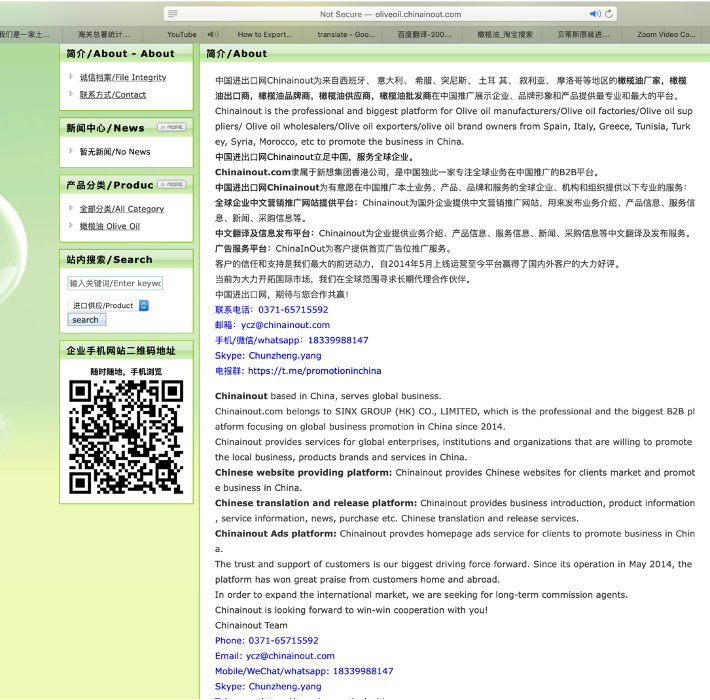
Chinainout is a leading and professional platform for foreign manufacturers to promote business in China.

http://oliveoil.chinainout.com is a website specifically designed for olive oil products, however most of the information on this site is about companies from Spain, Italy, Greece, Tunisia, Turkey, Syria, and Morocco. Initial review of the site shows no information regarding American olive oil companies currently selling in China.

There are also business directories for sale online which include olive oil import/export company introductions and contact information. The olive oil bottle prices range from 280 RMB—7800 RMB ($40 USD — $1100 USD).

Figure 1: ChinaInOut Website

Q3: Do buyers in China prefer to purchase in large volume containers (1-liter, 2-liter, 5-liter, or larger) or 250ml and 500ml bottles?

750ml is the most popular size since olive oil products are consumed as gifts in China. Also, they often come with well-made giftable boxes. 1-liter and 5-liter are also popular sizes for household use.

Q4: Who is responsible for import licenses? Are import licenses handled by the buyer in China or seller in the US?

Buyers are responsible for import licenses. 

Q5: What is the market price for gourmet olive oil in China?

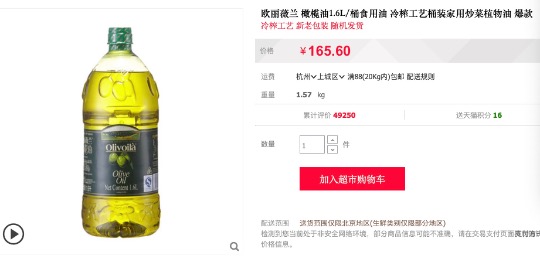
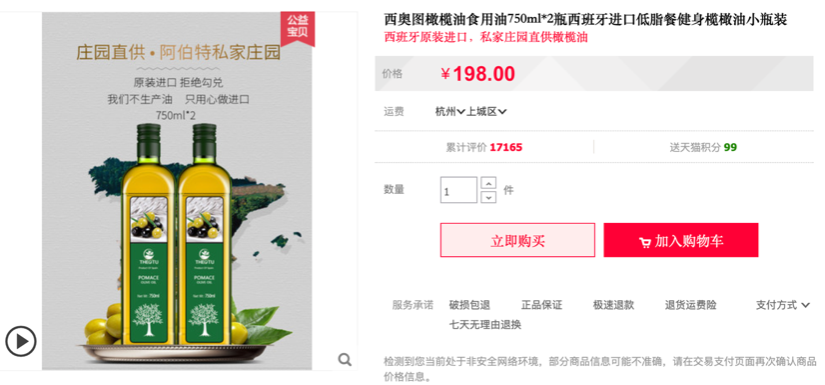
The following table shows the top 10 olive oils available in the Chinese market, according to sales in Tmall by Alibaba.

Brand: Betty VallandPrice: 115RMB ($16.4 USD) 5LMade in China, Fujian Province20,000 bottles sold per month 
Brand: OlivoilaPrice: 218 RMB ($31.1 USD)  750ml*2 Made in China, Shanghai, 10,090 bottles sold per month 
Brand: Theotu Price: 49 RMB ($7 USD) 750ml, Made in Spain9,500 bottles sold per month 
Brand: OlivoilaPrice: 165.60 RMB ($23.5 USD) 1.6LMade in China, Shanghai6,000 bottles sold per month 
Brand: BellinaPrice: 99RMB ($14.1 USD) 750ml, Made in Spain4,722 bottles sold per month 
Brand: Theotu, Price: 198 RMB ($28.2 USD) 750ml*2Made in Spain4,713 bottles sold per month 
Brand: MuelolivaPrice: 25.9 RMB ($3.9 USD) 250mlMade in Spain4,266 bottles sold per month 
Brand: BetisPrice: 48 RMB ($7 USD) 250mlMade in Spain3,854 bottles sold per month 
Brand: OlivoilaPrice: 165 RMB ($23.5 USD) 750ml*2  Made in China, Shanghai3,388 bottles sold per month 
Brand: BetisPrice: 258 RMB ($36.8 USD) 500ml*2Made in Spain3,339 bottles sold per month 


Q6: Are there any other fees or licenses required to sell olive oil to buyers in China?

Information, Procedures and Tariffs Required to Import Olive Oil

A. Qualifications required by domestic consignees (companies) of olive oil imports:

  1. Food business qualification or food circulation license
  2. Import and export rights
  3. Automatic import license

B. Information required for edible oil import declaration:

  1. The official certificate of origin
  2. Official health certificate of producing country
  3. Manufacturer’s ingredient list
  4. Manufacturer’s product inspection report
  5. Proof that the product is registered and approved for sale in its country (region)
  6. One copy of the original packaging label sample and three copies of the Chinese and English label sample
  7. The official quarantine certificate of the quarantine manufacturer

C. Proof/license documents need to be provided before import

  1. The official certificate of origin
  2. Official health certificate of producing country
  3. Manufacturer’s ingredient list

D. Olive oil import duty rate:

  Import tariffs VAT Comprehensive tax rate
Virgin olive oil  10% 13% 24.3%
Extra virgin olive oil 10% 17% 28.7%

E. Olive oil import declaration process:

  1. Sign contract
  2. Replacement order
  3. Customs declaration pre-record
  4. Three inspections: Commodity, animal and plant, and sanitary inspections
  5. Sampling and submission inspection (if randomly selected)
  6. Customs document release and tax release form*
  7. Tax payment
  8. Customs inspection (if randomly selected)
  9. Customs electronic release
  10. Delivery of goods

Q7: Is it sustainable to sell olive oil via cross border e-commerce?

Cross border e-commerce can be a very successful business model. There are many companies that have succeeded immensely this way.

But the Chinese government has started to clamp down on cross border sales due to issues with everything from salmonella contamination to expired products.

China has also introduced a Positive List. Only products that fall into one of the categories on the Positive List can be imported into China through a cross-border eCommerce model.

In April 2016, China issued two versions of the “Positive List” for cross-border eCommerce, with the more complete version listing a total of 1,293 categories of products. This list was updated in 2018, taking that total to 1,321 product categories.

Fortunately, olive oil is included in the positive list, falling under the following tariff codes and descriptions:

15091000   Virgin olive oil

15099000   Refined olive oil

15100000   Other olive oils

Q8: Any other helpful information to successfully sell US olive oil to Chinese buyers?

If you plan to sell online in China, you have two main options:

  1. Sell the products both in-country and online. Selling in-country and on websites like Tmall will give you exposure to around 550 million consumers. 
  • Sell via cross border e-commerce, on websites like Tmall Global, avoid lengthy registration processes, and have lower costs. This is a fast track option for initial sales into the Chinese market.

The second option gives you exposure to around 100 million consumers and is recommended for companies that are less experienced in the Chinese market.

Summary

Olive oil is becoming increasingly popular in China where Spain is the biggest exporter, contributing to more than 80% of the market. Italy, Greece, and Turkey are seeing increased sales of olive oil in China.

Selling via cross border e-commerce is easier and less costly compared to traditional imports, as international companies don’t currently need to register with local authorities, provide test reports, or comply with the China Guobiao (GB) national testing certification standards.


Sources:

Information, Procedures and Tariffs Required to Import Olive Oil: China Customs

Positive List Helper: https://www.tmogroup.asia/china-positive-list/

*Imported olive oil customs clearance supervision certificate 7A. 7 refers to automatic permit; A refers to inbound cargo clearance form. Submit the certificate of origin of the exporting country and file it on the consignee’s website at ire.customs.cn

This report was researched and prepared by Kimberly Yinhua Kim, International Business Development Specialist at Intelliwings

For more information, please contact info@intelliwings.com