| By Xuan Zhong | South Korean tech companies Samsung and SK Hynix may import US chip-making equipment for their factories in China, but major upgrades are still prohibited.


| By Xuan Zhong | South Korean tech companies Samsung and SK Hynix may import US chip-making equipment for their factories in China, but major upgrades are still prohibited.

| By Eliana Pisons | China has made impressive advances in the EV sector, putting it at the forefront of green transportation, setting new norms, and altering how the world thinks about sustainable mobility.

| By Linyi Zheng | China highlighted increased Middle East trade and energy deals and initiatives at last week’s 6th China-Arab States Expo held in Yinchuan, China.

| By Eliana Pisons | BRICS continues to emerge as a notable driving force with an ambitious mission that has the potential to reshape the global landscape.

| By Xuan Zhong | Huawei unveiled its Mate60 Pro phone, showcasing an advanced Chinese-made chip despite being under tech trade sanctions led by the US and US-allied countries.

| By Eliana Pisons | The August 18 Camp David Summit between the US, Japan, and South Korea has ushered in a new age of cooperation while tackling regional concerns.

| By Xuan Zhong | China is expanding its international space partnerships by creating programs to access lunar mineral samples and conduct research on China’s Tiangong space station.

| By Eliana Pisons | President Joe Biden has taken a decisive step in recalibrating U.S.-China economic relations by instituting a ban on American companies’ investments in specific Chinese technologies. This move was revealed August 9, 2023, when he signed an executive order that will restrict investments and require government notification in other tech sectors. He intends to stop Beijing from receiving American assistance in hopes to quell their military expansion.

Introduction
The cybersecurity threat to satellites will continue to increase as state-sponsored hackers, criminal organizations, terrorists, and individual hackers and hacking groups seek to disrupt satellite networks for espionage, financial gain, political objectives, to create disorder, or acquire fame among other hackers. Establishing a strong defense against these threats requires a holistic approach that addresses the different aspects of cybersecurity throughout the satellite control system including computer network security, physical security, personnel security, and satellite production supply chain security. All of these system components create an opportunity for hackers to attack a satellite network. This report will examine how hackers have attacked satellite control networks and discuss priorities and recommendations for defending against this threat.
Current Threats
Hacking components of satellite networks has been an ongoing threat for many years. There have been several documented cases of cyberattacks targeting satellite control networks, personnel, technology, and infrastructure throughout the years.[i], [ii],[iii],[iv],[v],[vi],[vii],[viii],[ix]
These attacks are probably not the only intrusions to have occurred. Skilled hackers have likely gained additional unauthorized access to satellite control systems without being detected. Accordingly, it’s essential to understand the particular vulnerabilities in satellite control networks.
Satellites and their control networks are vulnerable to a variety of cyberattacks and intrusions. Mr. Martin Rutishauser, an authority on penetration testing and satellite cybersecurity, detailed ten categories of satellite vulnerabilities at the Hashdays Security and Risk Conference 2012 in Lucerne, Switzerland. These vulnerabilities range from innocuous tracking and monitoring of satellite orbits through actual physical destruction of a satellite:[xi]
These vulnerabilities can be exploited by hackers if satellite control networks are not properly secured against cyberattacks.Although comprehensive cybersecurity is essential to protect satellite control networks, a prioritized approach should be implemented to defend against the most pressing and likely threats in conjunction with creating a comprehensive cybersecurity plan to defend against all threats.
Satellite Cybersecurity Priorities
Among the many threats targeting satellites and their control networks, non-kinetic cyberattacks including jamming communications and hacking into satellite control networks are the most significant and prolific threats.[xii] Defending against these primary threats should be the first priority in developing and implementing cyber defense strategies by using anti-jamming, encryption, and network security tools, technology, and techniques to counter these threats while working with external organizations to collectively pool knowledge and resources regarding the dynamic threat.
Anti-Jamming: US Army Major General Peter Gallagher, Director of Architecture, Operations, Networks, and Space for the Army Chief Information Officer emphasized the importance of protecting satellite communications against jamming during discussions at the MilSatcom USA Conference on June 29th, 2017. “The biggest thing that we need is protected satcom, anti-jam capability, in the future. Anticipating future threats and making sure we address them, I think that’s the most critical thing.” [xiii] Accordingly, current space systems need to be evaluated for suitability for upgrading anti-jamming capabilities and future systems must have anti-jamming capabilities included as part of their design.
Encryption: The Chatham House satellite cybersecurity report, “Space, the Final Frontier for Cybersecurity” notes the primary need for encryption in space systems. The report asserts that although it is not a comprehensive solution to counter every potential threat, the use of secure encryption is considered to be the best defense for space systems.[xiv] The challenge, though, is how to get cybersecurity added to control systems that are already in place on the ground and into satellites in orbit. Patricia Lewis, a research director at Chatham House explained “A large part of the critical infrastructure is sitting up there and not a lot can be done about it – it’s very old technology and it has never had any cyber protection built in. So the big question there is how much can they be retrofitted and what happens going forward.”[xv]
Cybersecurity companies are solving this problem by developing software and hardware solutions that can be retrofitted into existing networks and be a core component in the design of new networks. The cybersecurity company Fornetix has invented an encryption key management system called Key Orchestration that can dynamically distribute encryption keys throughout existing networks. This dynamic encryption capability provides an exceptionally strong layer of cyber defense that can be rapidly changed to protect networks against repeated cyberattacks.
Network Security: State-supported, criminal, and non-state hackers are adept at penetrating networks and infecting systems with viruses and ransomware. Brian Teeple, the Deputy Chief Information Officer for Command, Control, Communications, and Computers (C4) and Information Infrastructure Capabilities at the Department of Defense stated “The need for [network cybersecurity] protection is important because adversaries can attack any point in a system. It comes down to ‘what is the weakest link? What are they going to go after? You have to start looking at terminals and user equipment like they’re computers. There are cyber vulnerabilities and we’ve got to get cyber protections in place.”[xvi] This weakest link was echoed by Lisa Forte, founder of Red Goat Cybersecurity, when she highlighted the vulnerability of equipment in satellite ground stations, supply chains, and staff that will be actively targeted by hackers employing increasingly sophisticated cyberattacks, social engineering, and new artificial intelligence (AI) hacking tools on a massive scale.[xvii]
It is vital for network managers to anticipate both deliberate cybersecurity attacks as well as unintentional infections from authorized users unwittingly exposing networks to viruses via infected e-mail attachments, malicious websites, and improperly sanitized removable media from office and home computers. The STUXNET virus in Iran and the agent.btz virus on US CENTCOM military computers spread through systems lacking adequate and current security.[xviii] Satellite control networks need to be isolated from connections to external networks and require layered defenses that presume cyberattacks and unintentional exposure to viruses by authorized users will occur. Moreover, steps need to be taken to ensure network system suppliers are not providing components that have cyber vulnerabilities or surreptitiously pre-installed malicious software. Hughes Network Systems, for example, is a satellite production company that vets suppliers that use components from sources that have been identified as potential threats by the US government.[xix] Intelsat also works with independent cybersecurity companies to analyze hardware and software sold by suppliers in order to ensure no cyber vulnerabilities exist in the components being sold.[xx]
Cooperative Agile Cyber Defense: No single organization can find, fix, and fight all cybersecurity threats. The threat changes too quickly and different threats appear at different locations. Accordingly, organizations need to work with cybersecurity teams outside their own organizations and exchange threat information among these external organizations. Enlisting certified cybersecurity penetration teams from outside an organization who know about satellite control systems and can conduct independent security risk assessments is an essential and continuous requirement to ensure networks maintain strong security.[xxi] In addition, Inmarsat shares cybersecurity threat information with a variety of organizations including not only business partners, government agencies, and suppliers but also industry competitors.[xxii] Similarly, industry can work with government and law enforcement agencies that have resources and information available to assist organizations to stay informed of the latest threats.[xxiii] Working with outside organizations to conduct network security testing and share the latest threat information leverages larger sources of current cybersecurity knowledge to better protect an organization’s network.
Recommendations
Based on the current space cybersecurity threat as identified by experts from industry, military, and government, Intelliwings recommends considering the following actions:
Implement an immediate security review:
Conduct a security policy and operations review:
Conclusion
Planning for security at the inception of system design is absolutely essential to maximize defenses against the ever-growing cyber threat and it also avoids potentially millions of dollars of added expenses that organizations will incur when adding cybersecurity as an afterthought.[xxvi] Although senior officials responsible for protecting satellite control systems have emphasized the primary importance of anti-jamming, encryption, network security, and cooperative agile defense in satellite systems, it’s necessary to expand from these core components of satellite cybersecurity and ensure a comprehensive and holistic approach is implemented to promote cybersecurity in all aspects of network, physical, personnel, and satellite production supply chain security.
Cybersecurity is a core priority. This mindset needs to be shared by all team members involved in satellite operations, from initial design through end users, to ensure the safety and security of the system. The threat against the system is real, but organizations can successfully defend against this dynamic threat when given the resources and training necessary and in active and continuous cooperation with internal and external network cybersecurity experts and organizations.
The report was prepared by Intelliwings, LLC. For additional information, please contact info@intelliwings.com.
The following sources are recommended for additional research and information:
Endnotes
[i] Paganini, Pierluigi. “Hacking Satellites … Look Up to the Sky”, Infosec Institute, http://resources.infosecinstitute.com/hacking-satellite-look-up-to-the-sky/, September 13, 2013.
[ii] Bichler, Stephen F. “Mitigating Cyber Security Risks in Satellite Ground Systems”, Air Command and Staff College, Air University, Maxwell Air Force Base, Alabama, www.dtic.mil/dtic/tr/fulltext/u2/1012754.pdf, April 2015.
[iii] Flaherty, Mary Pat; Samenow, Jason; and Rein, Lisa. “Chinese Hack U.S. Weather Systems, Satellite Network”, The Washington Post, https://www.washingtonpost.com/local/chinese-hack-us-weather-systems-satellite-network/2014/11/12/bef1206a-68e9-11e4-b053-65cea7903f2e_story.html, November 12, 2014.
[iv] Newcomb, Alyssa. “Hacked in Space: Are Satellites the Next Cybersecurity Battleground?”, NBC News, http://www.nbcnews.com/storyline/hacking-in-america/hacked-space-are-satellites-next-cybersecurity-battleground-n658231, October 3, 2016.
[v] Syeed, Nafeesa. “Outer-Space Hacking a Top Concern for NASA’s Cybersecurity Chief”, Bloomberg, https://www.bloomberg.com/news/articles/2017-04-12/outer-space-hacking-a-top-concern-for-nasa-s-cybersecurity-chief, April 12, 2017.
[vi] Ibid, Bichler, page 16.
[vii] Rogin, Josh. “The Top 10 Chinese Cyber Attacks (That We Know of)”, Foreign Policy, http://foreignpolicy.com/2010/01/22/the-top-10-chinese-cyber-attacks-that-we-know-of/, January 22, 2010.
[viii] Khandelwal, Swati. “Satellite Phone Encryption Calls Can be Cracked in Fractions of a Second”, The Hacker News, http://thehackernews.com/2017/07/satellite-phone-encryption.html, July 10, 2017.
[ix] Evans, Steven. “North Korea ‘Jamming GPS Signals’ near South Border”, BBC News, http://www.bbc.com/news/world-asia-35940542, April 1, 2016.
[x] “Significant Cyber Incidents”, https://www.csis.org/programs/cybersecurity-and-governance/technology-policy-program/other-projects-cybersecurity, 2019.
[xi] Rutishauser, Martin. “Satellite Hacking: An Introduction”, DefCon Switzerland HashDays Security & Risk Conference 2012, Lucerne, Switzerland, https://www.indianz.ch/download/IndianZ_SatelliteHacking.pdf, October 31, 2012 – November 3, 2012. Mr. Rutishauser’s complete satellite cybersecurity presentation is also viewable on YouTube at https://www.youtube.com/watch?v=xIsG8GpB67A.
[xii] Daniels, Jeff. “Space arms race as Russia, China emerge as ‘rapidly growing threats’ to US”, CNBC, http://www.cnbc.com/2017/03/29/space-arms-race-as-russia-china-emerge-as-rapidly-growing-threats-to-us.html, March 29, 2017.
[xiii] Swarts, Philip. “Satcom’s Top Priority Should be Better Protection, Experts Say”, Space News, http://spacenews.com/satcoms-top-priority-should-be-better-protection-experts-say/, July 5, 2017.
[xiv] Livingstone, David and Lewis, Patricia. “Space, the Final Frontier for Cybersecurity?”, page 14, Chatham House, The Royal Institute of International Affairs, International Security Department, https://www.chathamhouse.org/sites/files/chathamhouse/publications/research/2016-09-22-space-final-frontier-cybersecurity-livingstone-lewis.pdf, September 2016.
[xv] Burgess, Matt. “Hackers Targeting Satellites Could Cause ‘Catastrophic’ Damage”, Wired, http://www.wired.co.uk/article/satellites-vulnerable-hacking-chatham-house, September 22, 2016.
[xvi] Ibid, Swarts.
[xvii] Holmes, Mark. “Cyber Expert Lays Out Threat to the Satellite Industry”, Satellite Today, http://interactive.satellitetoday.com/via/june-2018/cyber-expert-lays-out-threat-to-the-satellite-industry/, May 2018.
[xviii] Ibid, Bichler, page 14.
[xix] Werner, Debra. “Who’s Keeping Satellites Safe from Cyberattacks?”, SpaceNews.com, http://spacenews.com/whos-keeping-satellites-safe-from-cyberattacks/, April 19, 2017.
[xx] Ibid, Werner.
[xxi] Ibid, Bichler, page 25.
[xxii] Werner, Debra. “Protecting Satellites from Cyber Attacks Isn’t Getting Any Easier”, SpaceNews.com, http://spacenews.com/protecting-satellites-from-cyber-attacks-isnt-getting-any-easier/, March 9, 2017.
[xxiii] Pomerleau, Mark. “When it Comes to Cybersecurity, the Satellite Industry Stands Out”, C4ISRNET, http://www.c4isrnet.com/special-reports/satcom/2017/03/08/when-it-comes-to-cybersecurity-the-satellite-industry-stands-out/, March 8, 2017.
[xxiv] Fornetix Key Orchestration, https://www.fornetix.com
[xxv] Center for Internet Security, https://www.cisecurity.org
[xxvi] Lockheed Martin was awarded a $15 million contract on 15 March 2017 to improve the cybersecurity of US Air Force Space-Based Infrared System (SBIRS) ground system components. Swarts, Philp. “Lockheed Martin wins $15 million modification for SBIRS contract”, SpaceNews.com, http://spacenews.com/lockheed-martin-wins-15-million-modification-for-sbirs-contract/, March 15, 2017.

| By Kimberly Kim |
Q1: Is there any interest from Chinese buyers to purchase US olive oil?
The Chinese middle class is booming and imports of foreign products continue to grow. Chinese consumer market interest in foreign olive oil has experienced an increase in recent years. As more and more Chinese consumers start to appreciate foreign food, especially salads, Chinese imports of olive oil will most likely continue to increase in the coming years.
By far the most imports of olive oil are coming from Spain, which takes more than 80% of the market in China.
80% of the olive oil is consumed in first-tier cities like Shanghai and Beijing. This doesn’t come as a surprise as these cities are more developed, with people who have more money and a stronger desire to try out Western products.
Chinese consumers mainly prefer extra-virgin oil. Pricing your products at a higher level might not necessarily adversely impact sales, especially as cross-border sales tend to have high logistics costs.
Q2: Is there an agency or business consortium in China sellers can contact that buys US olive oil?
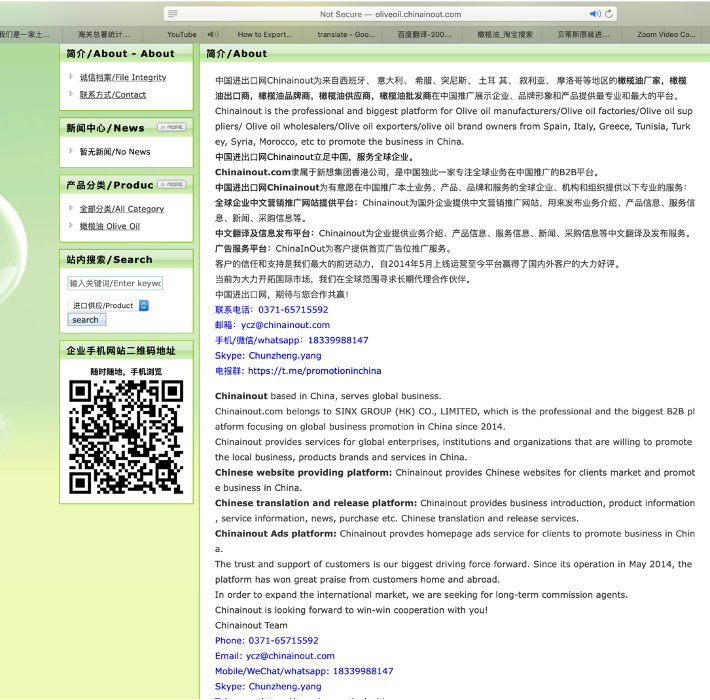
Chinainout is a leading and professional platform for foreign manufacturers to promote business in China.
http://oliveoil.chinainout.com is a website specifically designed for olive oil products, however most of the information on this site is about companies from Spain, Italy, Greece, Tunisia, Turkey, Syria, and Morocco. Initial review of the site shows no information regarding American olive oil companies currently selling in China.
There are also business directories for sale online which include olive oil import/export company introductions and contact information. The olive oil bottle prices range from 280 RMB—7800 RMB ($40 USD — $1100 USD).
Q3: Do buyers in China prefer to purchase in large volume containers (1-liter, 2-liter, 5-liter, or larger) or 250ml and 500ml bottles?
750ml is the most popular size since olive oil products are consumed as gifts in China. Also, they often come with well-made giftable boxes. 1-liter and 5-liter are also popular sizes for household use.
Q4: Who is responsible for import licenses? Are import licenses handled by the buyer in China or seller in the US?
Buyers are responsible for import licenses.
Q5: What is the market price for gourmet olive oil in China?
The following table shows the top 10 olive oils available in the Chinese market, according to sales in Tmall by Alibaba.
 |
Brand: Betty VallandPrice: 115RMB ($16.4 USD) 5LMade in China, Fujian Province20,000 bottles sold per month |
 |
Brand: OlivoilaPrice: 218 RMB ($31.1 USD) 750ml*2 Made in China, Shanghai, 10,090 bottles sold per month |
 |
Brand: Theotu Price: 49 RMB ($7 USD) 750ml, Made in Spain9,500 bottles sold per month |
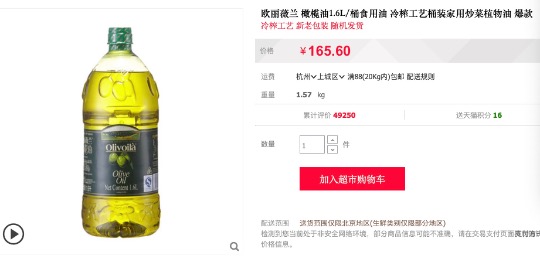 |
Brand: OlivoilaPrice: 165.60 RMB ($23.5 USD) 1.6LMade in China, Shanghai6,000 bottles sold per month |
 |
Brand: BellinaPrice: 99RMB ($14.1 USD) 750ml, Made in Spain4,722 bottles sold per month |
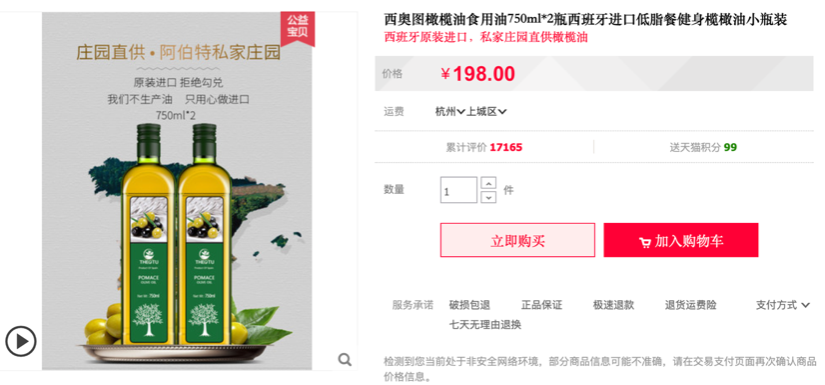 |
Brand: Theotu, Price: 198 RMB ($28.2 USD) 750ml*2Made in Spain4,713 bottles sold per month |
 |
Brand: MuelolivaPrice: 25.9 RMB ($3.9 USD) 250mlMade in Spain4,266 bottles sold per month |
 |
Brand: BetisPrice: 48 RMB ($7 USD) 250mlMade in Spain3,854 bottles sold per month |
 |
Brand: OlivoilaPrice: 165 RMB ($23.5 USD) 750ml*2 Made in China, Shanghai3,388 bottles sold per month |
 |
Brand: BetisPrice: 258 RMB ($36.8 USD) 500ml*2Made in Spain3,339 bottles sold per month |
Q6: Are there any other fees or licenses required to sell olive oil to buyers in China?
Information, Procedures and Tariffs Required to Import Olive Oil
A. Qualifications required by domestic consignees (companies) of olive oil imports:
B. Information required for edible oil import declaration:
C. Proof/license documents need to be provided before import
D. Olive oil import duty rate:
| Import tariffs | VAT | Comprehensive tax rate | |
| Virgin olive oil | 10% | 13% | 24.3% |
| Extra virgin olive oil | 10% | 17% | 28.7% |
E. Olive oil import declaration process:
Q7: Is it sustainable to sell olive oil via cross border e-commerce?
Cross border e-commerce can be a very successful business model. There are many companies that have succeeded immensely this way.
But the Chinese government has started to clamp down on cross border sales due to issues with everything from salmonella contamination to expired products.
China has also introduced a Positive List. Only products that fall into one of the categories on the Positive List can be imported into China through a cross-border eCommerce model.
In April 2016, China issued two versions of the “Positive List” for cross-border eCommerce, with the more complete version listing a total of 1,293 categories of products. This list was updated in 2018, taking that total to 1,321 product categories.
Fortunately, olive oil is included in the positive list, falling under the following tariff codes and descriptions:
15091000 Virgin olive oil
15099000 Refined olive oil
15100000 Other olive oils
Q8: Any other helpful information to successfully sell US olive oil to Chinese buyers?
If you plan to sell online in China, you have two main options:
The second option gives you exposure to around 100 million consumers and is recommended for companies that are less experienced in the Chinese market.
Olive oil is becoming increasingly popular in China where Spain is the biggest exporter, contributing to more than 80% of the market. Italy, Greece, and Turkey are seeing increased sales of olive oil in China.
Selling via cross border e-commerce is easier and less costly compared to traditional imports, as international companies don’t currently need to register with local authorities, provide test reports, or comply with the China Guobiao (GB) national testing certification standards.
Sources:
Information, Procedures and Tariffs Required to Import Olive Oil: China Customs
Positive List Helper: https://www.tmogroup.asia/china-positive-list/
*Imported olive oil customs clearance supervision certificate 7A. 7 refers to automatic permit; A refers to inbound cargo clearance form. Submit the certificate of origin of the exporting country and file it on the consignee’s website at ire.customs.cn
This report was researched and prepared by Kimberly Yinhua Kim, International Business Development Specialist at Intelliwings
For more information, please contact info@intelliwings.com